
A patio should not leave rainwater sitting against your wall or running into the wrong part of the garden. Every property has different levels, soil and existing drainage. Our first question on a new patio or driveway is simple: where can the water safely go?
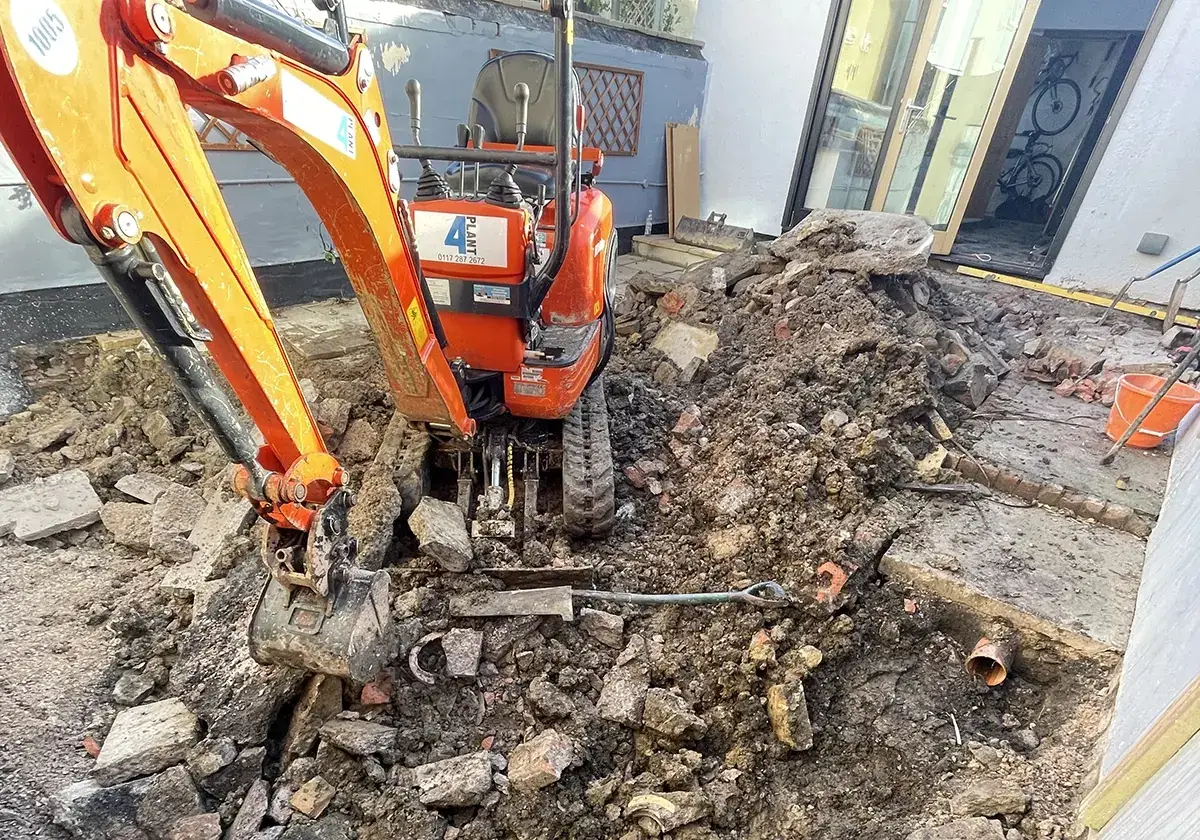
Look at the house and damp course first
We often see an old surface or raised ground close to a wall where the damp-proof course has effectively been bridged. The usual aim is to keep finished ground or paving at least 150 mm below the damp-proof course, where the building's construction allows it. Existing door thresholds and levels can make that difficult. We do not simply raise paving over the issue: we look at the wall, thresholds and available levels, then discuss an appropriate detail or specialist building advice where needed. A channel drain next to a wall is not, by itself, proof that a damp-course concern has been solved.
Give the water a route and a destination
We consider a fall away from the building or, where appropriate, towards a properly designed collection point. The gradient is only part of the answer. A channel drain still needs a suitable outlet; sending water into a low point without somewhere for it to go simply moves the puddle. We check the existing drains, the garden's levels and whether a suitable permeable area could receive the flow.
Connecting to an existing drainage system is not always feasible or appropriate. We first need to know what that pipe serves, whether a connection is permitted and whether it can carry the extra water. The same applies to discharging over a boundary or onto a road: those are not solutions to assume. For front driveways, the drainage design can also affect whether planning permission is needed.
A soakaway needs a test, not just an excavation
A soakaway may be an option if the property has suitable ground and enough space, but digging a hole and filling it with stone does not show it will work. A percolation or infiltration test checks how readily the ground takes water. Its results help establish whether a soakaway is viable and inform its sizing and location, together with the area draining to it and other property constraints. Heavy or saturated ground may call for a different solution. We would rather test and plan before construction than leave you with a soakaway that overflows in the first long wet spell.
Why every property needs its own answer
At one house, a suitable route may lead to a garden area that can absorb the water. At another, a correctly connected drain may be possible. Some sites need additional design or specialist input because neither a simple connection nor a soakaway is suitable. The right approach depends on the building, levels, soil, available outfall and applicable permissions.
When we discuss a patio or driveway, we will talk through the proposed falls and where the water goes. It should be clear in the specification before the paving is laid, not left to chance at the end.
Concerned about paving against your house or water pooling in the garden?
Tell us about your gardenGroundworks and drainage ↗What to ask about a quote ↗